
You sit at the piano after a long day, place your fingers on the keys, and a little voice pops up in your head.
“You started too late.”
“You’re not musical.”
“You’ll never catch up.”
That voice is not the truth. It is a collection of adult beginner piano myths that quietly slow your progress and drain your motivation.
If you feel behind, self‑conscious, or a bit embarrassed about how you play right now, you are not alone. The good news is that most of what holds adult beginners back is not age or talent, it is belief. Change the way you think, and your piano learning gets a lot lighter, and a lot more fun.
Let’s call out 5 common myths and replace them with practical, realistic habits you can use today.
Table of Contents
Myth 1: “I’m Too Old To Start Piano”
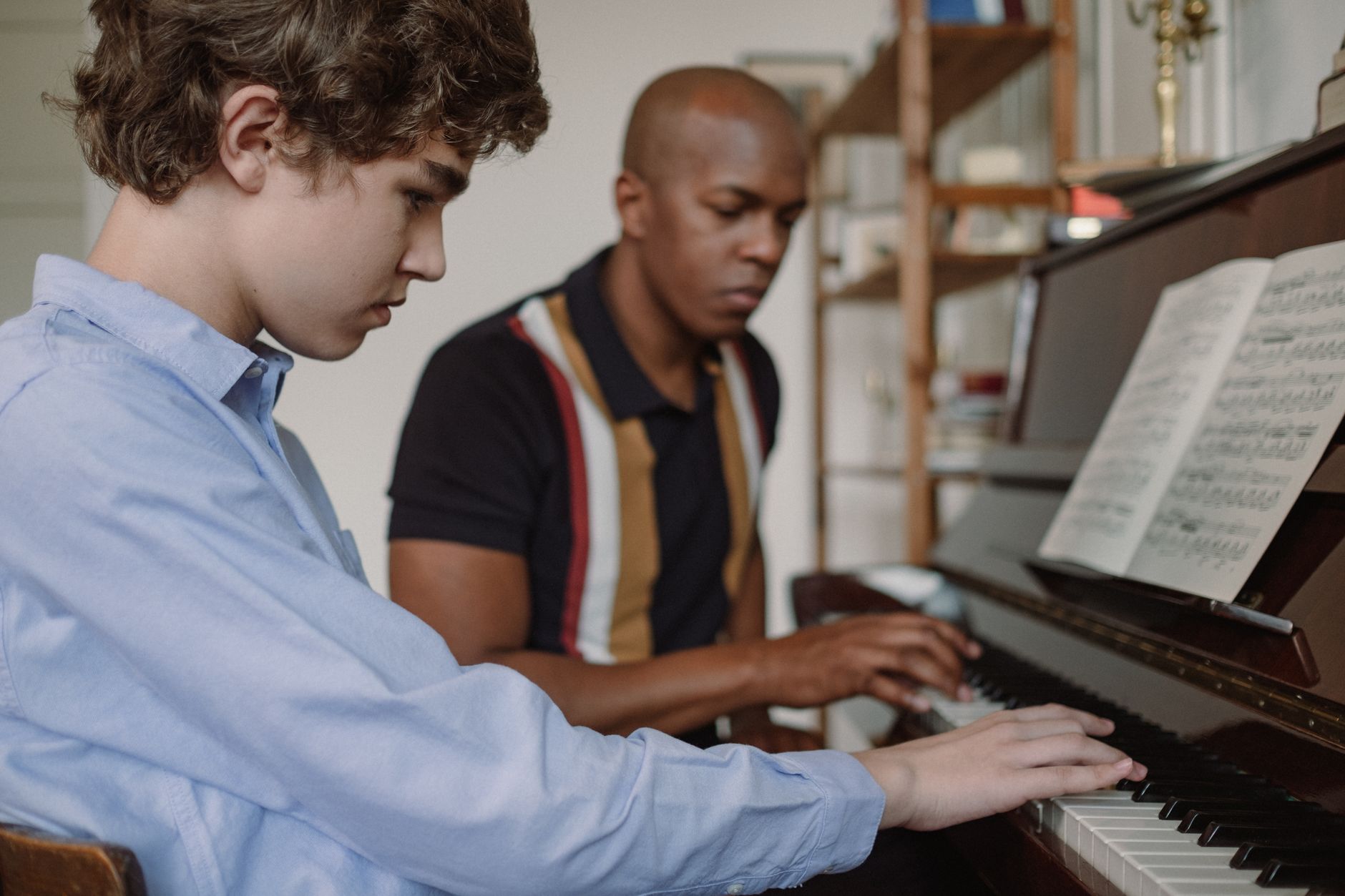
Photo by cottonbro studio
This might be the most common story adults tell themselves. Children learn faster, so you missed your chance, right?
Not at all.
Kids do have certain advantages. They often have more free time, and they grow up with fewer fears about looking “bad” at something. But you have strengths they do not have.
You bring:
- Life experience: You already understand patience and long goals.
- Clear motivation: You know why you want to play, which helps you stick with it.
- Better focus: Even short, focused practice can beat long, distracted sessions.
Piano learning is not like gymnastics where your body has to peak early. Your brain can keep building new connections at any age. Studies on adult learning show that practice quality matters far more than age.
A helpful mental shift: stop comparing your progress to a 10‑year‑old who started at 4. Compare yourself to the you from last month.
Could you play that simple chord pattern last month? Could you keep a steady beat in both hands? If the answer used to be “no” and is now “kind of”, you are winning.
Takeaway: Your age is not the problem. Inconsistent practice and harsh self‑talk are. Fix those, and your timeline opens up.
Myth 2: “If I Don’t Have Natural Talent, I’ll Never Sound Good”
Talent feels like magic. You see someone sit down and play by ear, and it looks effortless. So it is easy to think you are just not “born with it”.
Here is the honest part. Some people do pick up patterns faster, just like some people run faster. But what you see as talent is often thousands of hidden, messy practice hours.
When you say, “I am not talented”, what you often mean is, “I have not practiced like that yet.”
For an adult beginner, the biggest gains come from simple skills:
- Keeping a steady beat with a metronome (the little device that clicks in time).
- Playing hands separately before you join them.
- Repeating one small section until it feels easy.
None of that requires a gift from the universe. It asks for 10 to 20 minutes a day and a bit of patience.
If you want a simple test, try this:
- Pick a short piece or exercise, 4 to 8 bars long.
- Practice it slowly every day for a week, no longer than 15 minutes.
- At the end of the week, record yourself.
You will hear the difference. That small jump is what “talent” looks like on the inside. It is mostly repetition, curiosity, and staying calm when you mess up.
Takeaway: Natural talent might change your starting point. Daily practice decides your finish line.
Myth 3: “I Need Hours Of Practice Every Day To Improve”
This myth stops many adults before they even get started. You imagine a serious pianist practicing for 3 hours, then look at your life and think, “I barely have 20 minutes.”
Here is the truth. For most adults learning how to play piano, short, focused sessions are far more useful than rare, long marathons.
Think in terms of “good minutes”, not total minutes. A “good minute” has three parts:
- You know what you are working on.
- You are playing slowly enough to control mistakes.
- You are listening to your sound, not just pushing through.
A realistic, powerful structure could look like this:
- 5 minutes: warm up with a scale or simple finger pattern.
- 10 minutes: practice a tricky section of a piece, hands separately.
- 5 minutes: play something you enjoy, even if it is easy.
That is 20 minutes. If you can do that 4 or 5 days a week, you will see steady progress.
Think of it like brushing your teeth. You do not wait for a free Sunday and brush for an hour. You keep it short and regular, so things do not fall apart.
Takeaway: Consistency beats intensity. Aim for many small wins instead of one heroic session.
Myth 4: “I Have To Learn All The Music Theory Before I Can Really Play”
Theory is useful. It explains chords, key signatures, and why a song sounds the way it does. But treating theory as a gate you must pass before you touch real music is a fast way to kill joy.
You do not need to know every rule in order to learn how to play piano. You need just enough to support the piece in front of you.
For example, if your piece uses C, F, and G chords, then understanding those three chords and how they are built is plenty for now. You can add more as you meet them.
A good rule for adult beginners:
“Learn theory on a need to know basis, at the piano, not from a huge book.”
Try this blend:
- When you learn a new piece, circle repeated patterns. Those are usually simple chord shapes.
- Learn the name of that chord, and how to play it in both hands.
- Listen to how it feels. Happy, sad, tense, calm.
You start to connect sound, shape, and name, without drowning in terms.
If you love theory, great, dive deeper. If you do not, that is fine. Let theory be the tool, not the boss.
Takeaway: Theory should serve your playing. You do not have to study everything before you make real music.
Myth 5: “If I Make Mistakes, I’m Failing”
This one is painful, because it touches on pride. As adults, we are used to being competent at things. At work, with family, in daily life, we know what we are doing. Then piano learning comes along and suddenly we feel clumsy.
Many adults react by trying to hide mistakes. They rush through pieces, tense up, or stop as soon as something sounds bad.
But mistakes are not the enemy. They are feedback. They tell you exactly where to spend your next 5 minutes.
Here is a simple way to turn mistakes into a plan:
- When you stumble, stop.
- Isolate the smallest section that falls apart, maybe 2 beats.
- Slow that tiny part down until you can play it right 5 times in a row.
- Add a beat before and after, and repeat.
This is how real practice looks. It is not a perfect performance every time. It is lots of ugly, slow, focused loops on the hard bits, with relaxed breaths in between.
If you record your practice once a week, you will hear that your “bad” playing today is better than your “good” playing from a month ago. That shift builds confidence.
Takeaway: Mistakes are not proof that you cannot play. They are a map that shows you where to work next.
Putting It All Together For Faster Progress
Let’s connect all these myths into a simple way to approach your next practice week.
You now know that:
- Your age does not block you.
- Talent is less important than habits.
- Short, focused sessions work.
- You do not need all the theory at once.
- Mistakes are guides, not verdicts.
So what does that mean in daily life?
Here is a realistic plan:
- Pick one piece that feels just a bit hard, not impossible.
- Practice 15 to 25 minutes, 4 or 5 times this week.
- Use a metronome at a slow speed, so you can play without rushing.
- Break tricky spots into tiny chunks, and repeat them calmly.
- Notice one small thing that improved each day.
This is how to learn piano as an adult without guilt. Small steps, clear focus, and a kinder voice in your head.
Final Thoughts: Your Progress Is Not Late, It Is Yours
Those old stories in your mind will still try to speak up. “Too old.” “No talent.” “Not enough time.”
You do not have to argue with them. You can simply prove them wrong by sitting down at the keys, even for 10 minutes, and doing the next small thing.
Every time you choose practice over self‑doubt, you rewrite the story of what is possible for you. That is the real power of letting go of adult beginner piano myths.
Thank you for reading. If this helped shift your mindset, commit to one tiny change in your practice this week and see what happens. Your future self at the piano will be glad you did.

